The puzzle
For many years I couldn’t find my grandfather Sidney Walter JARVIS (1889-1986) in the 1891 census. He would have been just three weeks short of his second birthday when the census was taken on 5 April 1891.
By the time of the 1901 census the family are in Sheffield. The record shows his 16-year-old, eldest sister Hephzibah and two younger siblings Ruth, aged 8 and William, aged 6 as being born in Staplehurst, Kent. However, 11-year-old Sidney and his 13-year-old sister Annie are recorded as being born in Surbiton, Surrey. Surbiton is 50 miles north west of Staplehurst. What were my great grandparents doing in Surbiton for a period of up to 8 years between October 1884 (when Hepsy was born) and February 1893 (when Ruth was born)? Surely searches for at least one member of the family would help me locate the family in 1891? But no luck.
Of course their period of time in Surbiton could have been much shorter – Annie was born in June 1887 and Sidney in April 1889. My grandad said his parents returned to Staplehurst when he was two years of age. Could this mean the family was back in Staplehurst for the 1891 census? Perhaps they were moving and failed to complete the census?
For many years I tried unsuccessful to find the family in the 1891 census. All the time adding to these possible theories. Perhaps there was a hidden story of emigration followed by return?
The answer
In the end it was an all too frequent, ‘if all else fails, go back to basics’ approach that cleared up the mystery.
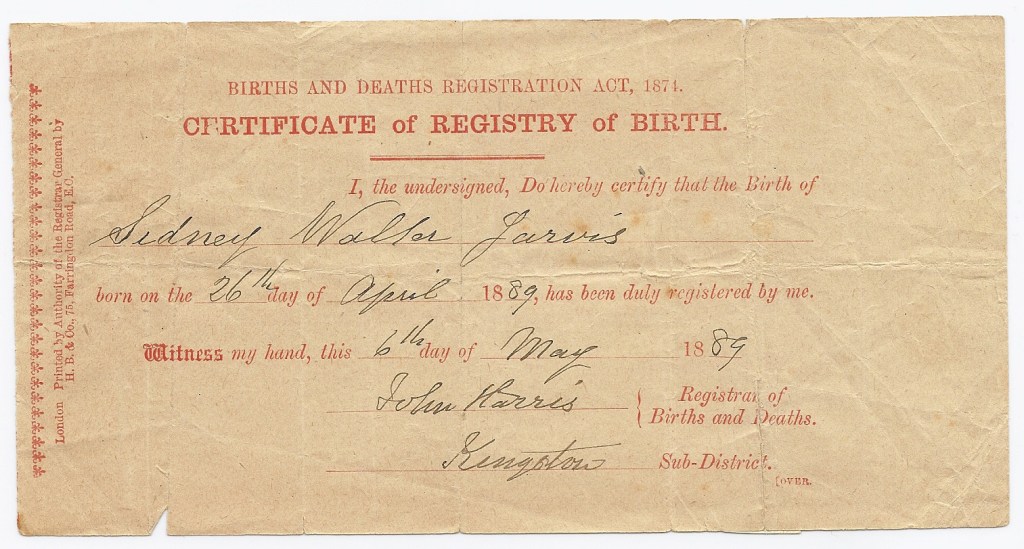
I’d never obtained a copy my grandfather’s birth certificate. We’d inherited a short form certificate (the featured image on this post). This confirmed the date and sub-district of his birth, so what would be the point of obtaining the full version? There could of course have been many surprises, but in this case the useful piece of information it gave me was the address where he was born: 37 Alpha Road, Surbiton. Who was living at that address at the time of the 1891 census?
And that turns out to be a more interesting question than usual. On both Ancestry and Findmypast the transcript of the 1891 census for Alpha Road begins with a page detailing the households at numbers 34, 33, 32, 31 and 30. Surely number 37 would be on the preceding page? But the page that stops at number 34 is annotated PAGE 3 (FRONT) and has clearly been damaged.
Bennett et al (2020) provides interesting insights into the storage of our census records and the lots of details on some of the registration districts with gaps. Missing first pages are relatively common, exacerbated by the Old Age Pensions Act (1908), because individuals who did not know and/or could not prove their birth date, or had no other evidence of age, could request an attested copy from the General Register Office (GRO) of a previous census that showed their age. The process required the frequent opening and closing of books by GRO clerks which could result in the first pages becoming detached.
The table on page 33 of Bennett et al (2020) estimates that perhaps 0.3% of the population are missing from the surviving 1891 census records.
But why were my great grandparents in Surbiton in 1891?
Why move to Surbiton from a village in Kent, only to return a few years later? My grandfather Sidney provides aclue when in his own jottings he records:
… my father had only casual work and mother did sewing and dress making which kept us alive.
On Sidney’s full birth certificate his father Charles William JARVIS (1861-1940) is recorded as a jobbing gardener, so this seems to be what he was doing in Surbiton. And it turns out that his brother in law Thomas ROBERTS (1867-1943) was also working as a gardener in Surbiton at the time of his marriage in 1892. Thomas was also born and raised in Kent, but something brought him to Surbiton. And he too seems to be missing in the 1891 census and so perhaps is at 37 Alpha Road or a neighbouring house.
Thomas remained a gardener all his life. Charles didn’t. In an earlier post I talked about my great grandfather’s hop-picking https://myancestors.blog/2023/09/11/hop-picking-in-kent/. He was also recorded in census and certificates as a bookseller, a farm labourer, a jobbing gardener, a coke loader at gas works, a furniture packer (furniture removers), a time-keeper (tool-works), a weigh clerk (tool-works), a jobbing gardener (master), a green grocer, and a dealer and hawker.
I could of course be entirely wrong, but the impression I have here is that great grandmother Ann ROBERTS (1859-1932) spent many years pushing her husband Charles to make something of himself and earn enough to provide for the family. It would have been Ann who was behind the move to Surbiton and Charles working with, or for, her brother. It clearly didn’t work out: Charles and family returned to Kent, whilst Thomas remained.
I wonder what took Thomas to Surbiton and whether it is possible to find out any more about this and his gardening exploits?
Bibliography
- 1901 census, RG13 Piece 4367; Folio 93; Page 35. 204 Brookhill, Sheffield, Yorkshire.
- 1891 census, RG12; Piece 613; Folio 1; Page 3. Alpha Road, Surbiton, Kingston, Surrey.
- Bennett, R., Van Lieshout, C., & Schürer, K. 2020. Missing in the Census 1851-1911: The ‘lost’, ‘missing’, and ‘gaps’ in I-CeM and BBCE, with weights to adjust RSD populations. Available at https://doi.org/10.17863/CAM.50179

 My Ancestors
Leave a comment