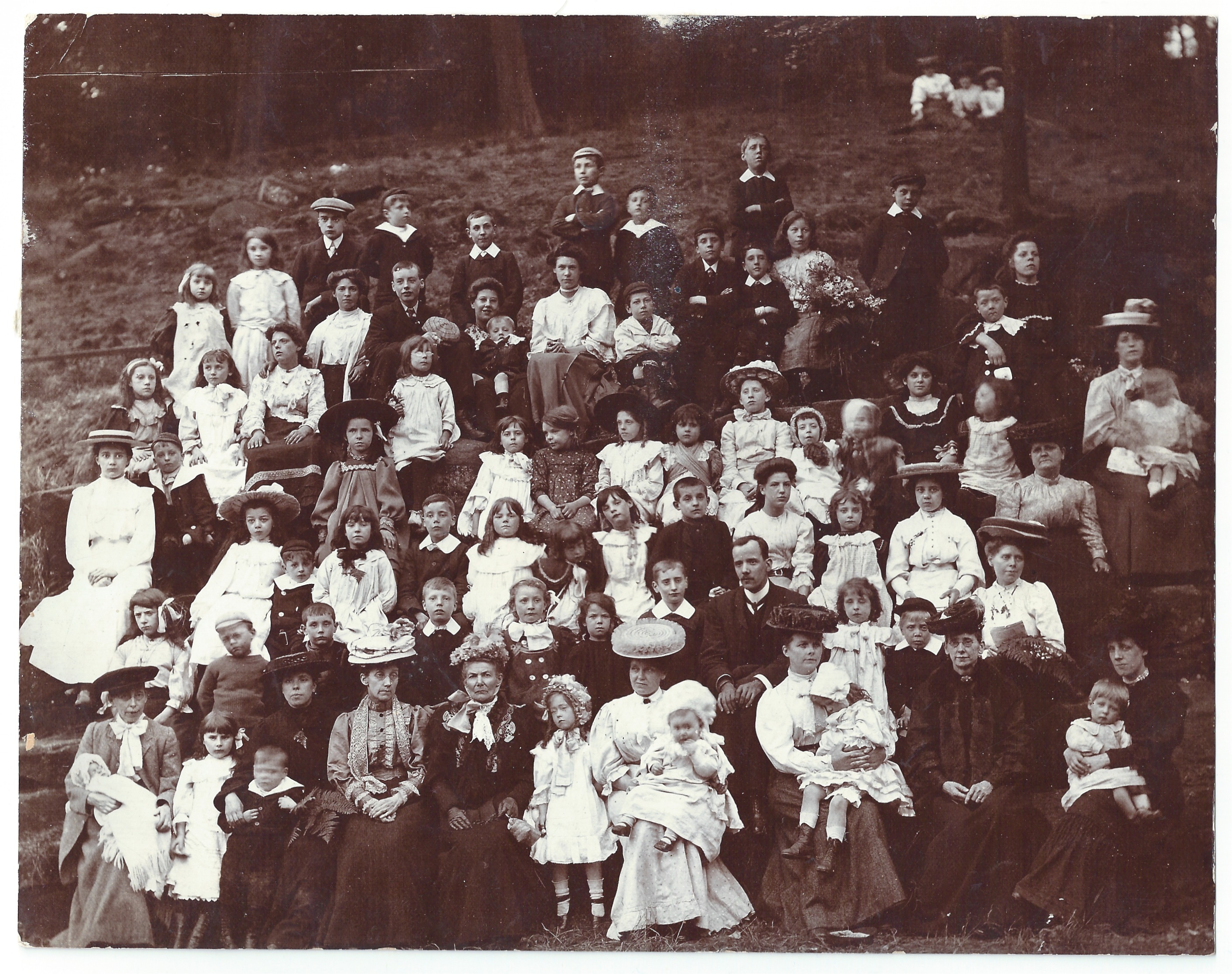
My great grandfather fascinated me as a young child because he had 4 names – Joshua Whitley Gill CLARK (1855-1901). Growing up, I didn’t ever came across anyone else with more than 3 names. Surely it was only royalty that had lots of names? Why would my great grandad?
Of course, researching the family history, I’ve come across a few more distant relations with 4 or occasionally even more names. My fascination moved on to the question of where the name WHITLEY had come from. Quite early on I learned that Joshua died before my grandfather was 5 years old and as a consequence Grandad was brought up largely by his aunt, Joshua’s youngest sister, Ann Whitley CLARK (1859-1927). That name WHITLEY again.
Joshua’s parents were my 2 x great grandparents William Taylor CLARK (1819-1902) and Martha Jane CLARK (1826-1891) nee GILL. So that explained the GILL, but not the WHITLEY. It took me a number of years to track down the origin of WHITLEY.
Martha Jane GILL’s baptism record shows that she was born 2 September 1826 and baptised just over 3 weeks later on 24th in Mirfield, Yorkshire. Her parents are recorded as Joshua GILL, a clothier and Ann. When she married William Taylor CLARK in 1844 (at the age of 17) in Hull she gave her name as Martha Jane Whitley GILL and her father is recorded as Joshua Whitley GILL, a waterman.
Exploring the records
Let’s look at what else we can easily find out about the family between 1826 and 1844. The most obvious starting point is the 1841 census. This shows Joshua WHITELEY [sic] (35), a waterman and Ann (35), together with their children Martha (14), Mary Ann (12), Joshua (2) and Margaret (10 months).
Perhaps I’ve simply got the records mixed up? Perhaps these are different families. Why would the family name change from GILL to WHIT[E]LEY and back to GILL? Why would a clothier become a waterman? (A waterman was someone who worked a bit like a taxi-driver, carrying people or goods across rivers.)
Piecing together more of the evidence
Using the baptism records for Joshua and Ann’s children and also those of at least two children who died – Jeremiah (1831-1834) and Joshua (1834-1836) – I discovered a consistent pattern, with the switch from clothier to waterman occurring some time between late 1831 and mid 1835 and the switch from GILL to WHITLEY occurring sometime in 1839 or 1840.
There’s also enough additional information to convince me I have the right family. For example Joshua W GILL and Ann and their younger children came to live with their daughter Martha after her marriage and whilst William Taylor CLARK was at sea.
Clothier to Waterman?
The WHITLEY/GILLs were living in Mirfield, Yorkshire. The Reverend Joseph Ismay was vicar of Mirfield from 1735 to 1778 and kept a detailed and informative journal. From him we know that in 1755 Mirfield day wages were:
- carpenters and masons: 1s. 3d
- labourers: 12d
- men servants for husbandry [looking after cattle]: 7d
- tailors: 6d (plus their victuals)
- clothiers: 5d
In other words clothiers were at the bottom of the economic ladder. The Reverend Ismay also says that in Mirfield in 1755 there were about 100 pairs of looms for the weaving of broad cloth, 200 persons employed in making of cloth and 400 in carding. spinning, and preparing wool for the looms.
Clothiers fared badly from the changes brought about by the industrial revolution. A letter in the Leeds Patriot and Yorkshire Advertiser in 1829 states:
… twenty years ago [the weavers] were in the possession of an adequate reward for their labour, and no class of labourers could be more contended and happy; their homes were abodes of neither poverty nor riches and a manly and honest reliance on their own exertions for a livelihood constituted the prominent feature of their pride – a characteristic which will be readily admitted to be of the most invaluable description by every one whose opinion is of any value. But the changes in their condition which the last few years has produced, is so marked and striking as to have left very few traces of their former character. A progressive reduction of their wages for weaving, unto less than one-third of its former amount, has gradually deprived them, first, of the comforts and conveniences, and latterly of many of the first necessities of life. The neat and useful articles of furniture which used to adorn their cottages have in most instances been sacrificed, either to satisfy their landlords for rent, or the more immediate and indispensable demands of their own families for bread; their clothing reduced to rags without a possibility of renewing it; and their pale and woe-worn countenances, are the melancholy evidences of the sad revolution that has taken place in their condition. And, as an aggravation to their mental sufferings, when they complain and state what they believe to be the causes of their privations, they are told by the Economists, that they have no knowledge of the science of political economy, and that they must first submit to some learned lectures, as the only means of enlightening their dark understandings, before they are qualified to appreciate the nature of their own situation!! [the cause of this transition was the introduction of Power Looms]. Source: Distress of the Hand-loom Weavers in Lancashire, Leeds Patriot and Yorkshire Advertiser, 3d.
There’s more detailed research to be done here, but I suspect Mirfield’s cloth industry was particularly badly impacted in the early 1830s, and I think it is this that led Joshua to become a waterman.
GILL to WHITLEY and back again?
To understand why Joshua might have changed the family name from GILL to WHITLEY I think we need to go back to his own baptism which took place on 7 July 1801 at St Mary, Mirfield. The entry reads:
Joshua, son of Martha GILL, reported father Benjamin WHITLEY
It appears that Martha GILL married Benjamin WHITLEY in 1805 and the couple had at least 6 children: 2 before they married and 4 after. Under nineteenth century law Joshua would have remained illegitimate even after his parent’s subsequent marriage. It’s therefore not surprising that when he married in 1824 his name is recorded as Joshua GILL – this would have been his legal name.
Why might Joshua change his name to WHITLEY around the end of the 1830s? In 1841 his father Benjamin is living on his own in Mirfield, still working as a clothier. I hadn’t managed to trace a death record for his wife Martha, but on a hunch from this analysis I checked the GRO references from 1 July 1837 (when they started) to June 1841 (when the 1841 census was carried out), and found Martha’s death certificate! She died 20 October 1837 at Daw Green, 3 miles east of Mirfield. The certificate confirms her husband is Benjamin, a clothier, also of Daw Green.
So my hypothesis is that Joshua understood that legally his name was GILL, but that after the death of his mother, he was keen to honour his father’s name. This is supported by the 1853 Administration Bond that forms part of the tying up of his Will. This identifies him as ‘Joshua WHITLEY-GILL, usually called Joshua WHITLEY’.
What have I learned?
It can be difficult to know what name to ascribe to an ancestor. Should we use their legal name, or the name by which they were known? What if either of these changed during their lifetime? I have another branch where a number of illegitimate births, followed by the parent’s marriage, led to some descendants being baptised with one name, some another, and still others adopting a hyphenated conjunction of the two.
This same point raises its head at a more granular level where you have a name like WHITLEY. Is it always WHITLEY or should I record it as WHITTLEY or WHITELEY when it appears with these different spellings in certificates or census records? It seems sensible to try to be consistent, but to add notes to document the variations. But this approach needs to change if the variant spelling gets passed down and used consistently in one branch of the family.
Finally, exploring this mystery helped me track down the death certificate of my 4 x great grandmother Martha WHITLEY (nee GILL). Mysteries are worth pursuing!
References
- 1841 census (JOSHUA WHITELEY [sic]): HO107 Piece 1270; Book 8; ED 1; Folio 6; Page 5; Line 17
- http://mirfield-2ndlook.info/Reverend_Joseph_Ismay_1/Ismay_Writings_2/ismay_writings_2.html
- Leeds Patriot and Yorkshire Advertiser, 28 Feb 1829, 3d
- 1841 census (Benjamin WHITTLEY [sic]) – HO107; Piece: 1269; Book: 7; ED: 14; Folio: 6; Page: 4; Line: 10


 My Ancestors
Leave a comment