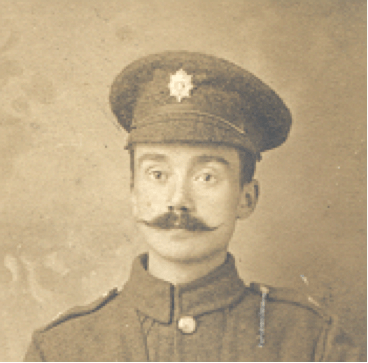
My grandad – Sidney Walter JARVIS (1889-1986) – never spoke about his experiences in the First World War.
Growing up in Kent
Sidney was a sickly child, diagnosed as having ‘a shadow on the lung’ and – as he used to joke to us long after his ninetieth birthday – his mother was told, ‘if you rear him above 21 you’ll be lucky’. He left school at thirteen and in some jottings about his early years wrote:
My father had only casual work and mother did sewing and dress making which kept us alive. Two parents and five children required good house-keeping and there were very few pennies left over … I did not like [school] as the best scholars were in the front row but I was in the back row. My elder sister had the task of taking me and I’m afraid I often made her late … one thing I remember at the school was a large map of the world with a lot of red patches which the teacher said represented places which belonged to the British Empire which was the largest empire the world had ever seen and which could not be beaten, which shows the teacher could not see the future any more than we saw and one more thing the teacher told us was we must raise our caps to the Squire and the Parson.
From Kent to Sheffield
The family moved from rural Kent to Sheffield in the late 1890s because Sidney’s father Charles William JARVIS (1861-1940) was always looking for work – the various census and certificates I have record him as bookseller, farm labourer, jobbing gardener, coke loader at gas works, furniture packer, time-keeper at tool works, weigh clerk at works, green grocer, and finally, on his death certificate, dealer and hawker.
In Sheffield grandad remembered children at school who were too poor to have shoes; jumping on the back step of trams whilst the conductor wasn’t looking (and falling off onto the cobbles); Old Tom who lived in a shed with nine cats; and an advert for Kelly’s herb beer that went something like, ‘If your decisions to keep your head clear, don’t drink nowt but Kelly’s herb beer. It’s good for your stummuck and runs down your throttle, its as easy as owt and a penny a bottle’.
Grandad was always drawing and painting, and worked as a silver chaser, first at W B Skerritt, 175 Brook Hill from 1903 to 1910, and then at Mappin & Webb’s Royal Works in Norfolk Street.
First World War
He worked At Mappin & Webb’s until he was called up to join the Royal Army Service Corp (563 Company, also known as the 16th Auxiliary (Omnibus) Company), where he served between April 1915 and June 1919 driving ambulances and troop lorries to and from the Front in northern France and Belgium.
He’s on the right in the photograph below, standing beside what looks like a British built, 3 ton truck built by AEC (Associated Equipment Company). Its four cylinder, Daimler 5.4 litre engine produced 40 horsepower – about a third the power of today’s small family cars – and its solid rubber tyres would no doubt have offered driver and passengers an ‘excellent’ feel of each and every pothole.
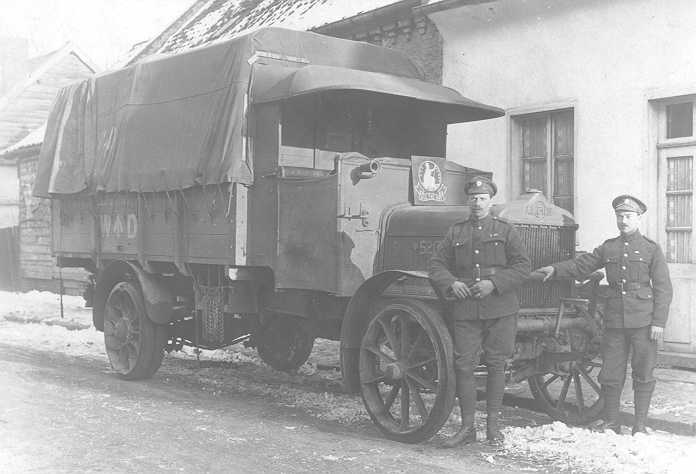
Grandad’s AEC truck around 1917. The W, pheon and D on the side simply indicate the truck is the property of the War Department.
Look closely just below where the windscreen would be if there was one, and you’ll see Sidney’s customisation – a drawing of a penny and an inscription below that reads ‘ONE PENNY ALL THE WAY’.
A letter to the Daily Mail in 1915 reports that the drivers enjoyed hot lunches, ‘Most of us prefer [our M and V ration (Meat and Vegetables together in a tin)] hot, and we have discovered the world’s simplest cookery. We wire our ‘M and V’ tins on to the exhaust pipes of our lorries about half an hour before meal times. When the halt is called all we have to do is lift the bonnet, cut the wire, open the tin and there you have a piping hot meal all ready to be eaten.’ The correspondent goes on to add, ‘I’m glad I’m not in the infantry, I am.’
Nothing good has ever come of war, was all grandad used to say. But he did say something more, because amongst his effects was this poem annotated, ‘written in an Army Lorry after taking troops in and out of Ypres’:
Ypres 1917
Gaze down upon yon ruined heap
Once t’was a City rich and fair
Where trade and commerce then did reap
Such benefits as it does bear
Now the scene would make one weep
For War hath laid its ravage there.
No more those noble buildings rise
As monuments of human skill
No more its steeples flaunt the skies
Or bells in them their work fulfil
But all is ruined and now lies
A hideous wreck, and deathly still.
Never was Pompeii more crushed
Though buried ‘neath a frightful load
As molton lava onward rushed
Spreading death along its road
To citizens who had not fled
But this was caused by different mode.
Caused my man’s lust and greed of gain
Not satisfied that they were great
Proud ambition turned their brain
And made them crave for more estate
This wars are caused and thousands slain
And thus this City now prostrate.
What tales of woe its streets could tell
Of endless suffering and pain
What terrors struck each heart when shell
Fell on that City like the rain
What numbers of its people fell
Victims of that vile lust of gain.
Now no children’s merry laughter
Rings through those streets as once it did
Free from care and thoughts of danger
As homeward from their school they sped
Now we hear a sound far stranger
Of shrieking, bursting shells o’erhead.
Now through its streets in constant stream
Troops, horses, wagons, motors pour
Such numbers as no one did dream
Would e’er exist before this war
Whilst overhead we catch a gleam
Of aircraft as they upward soar.
May those whose task it is to guide
In future countries great or small
When through dispute, called to decide
Twixt peace or war, then they recall
This ruined place, and those who died
And if results did balance all.
Bibliography
- The Daily Mirror, 4 May 1915, p12b

 My Ancestors
Leave a comment