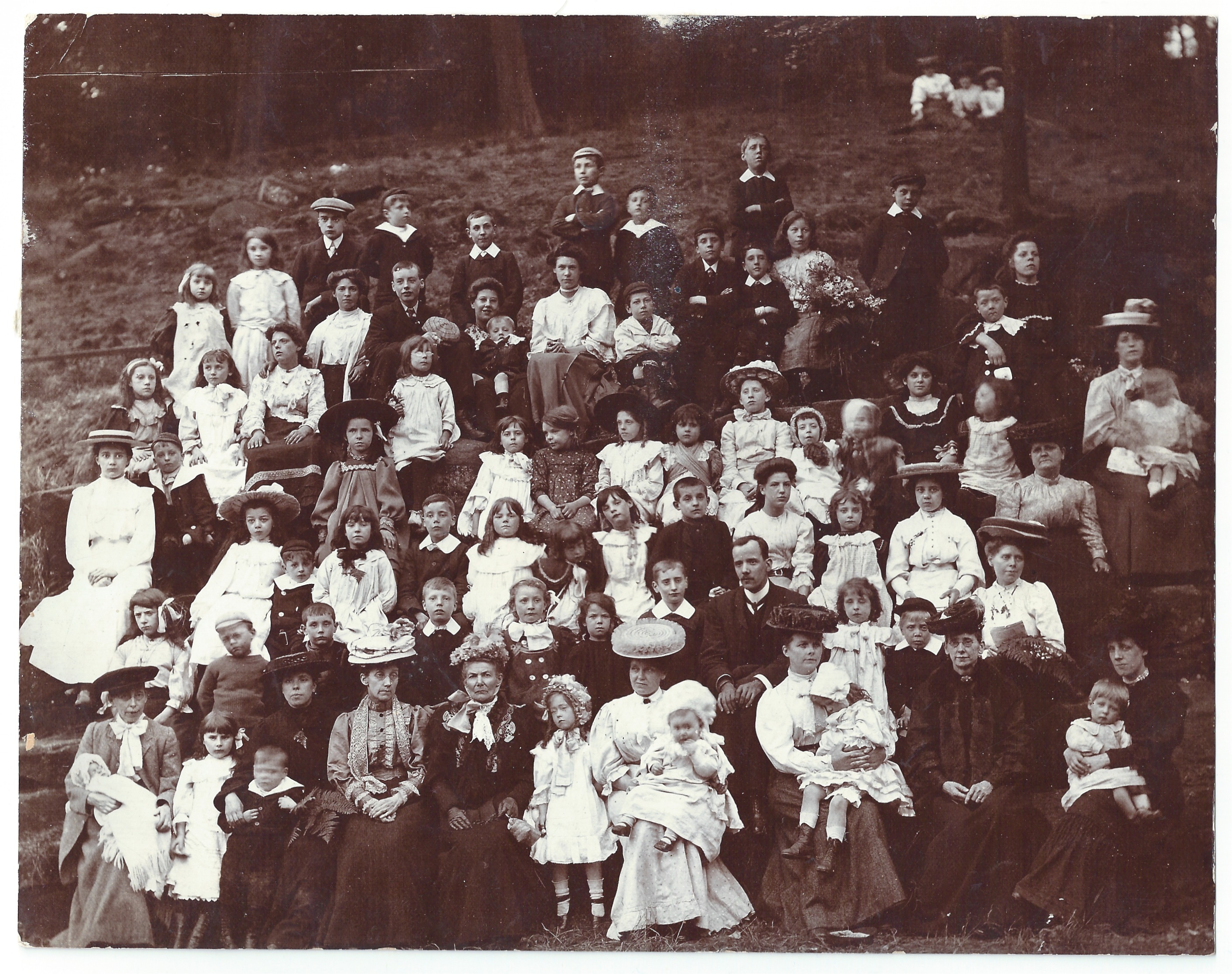
This story begins with a family photograph, dated in bold pencil 1926.
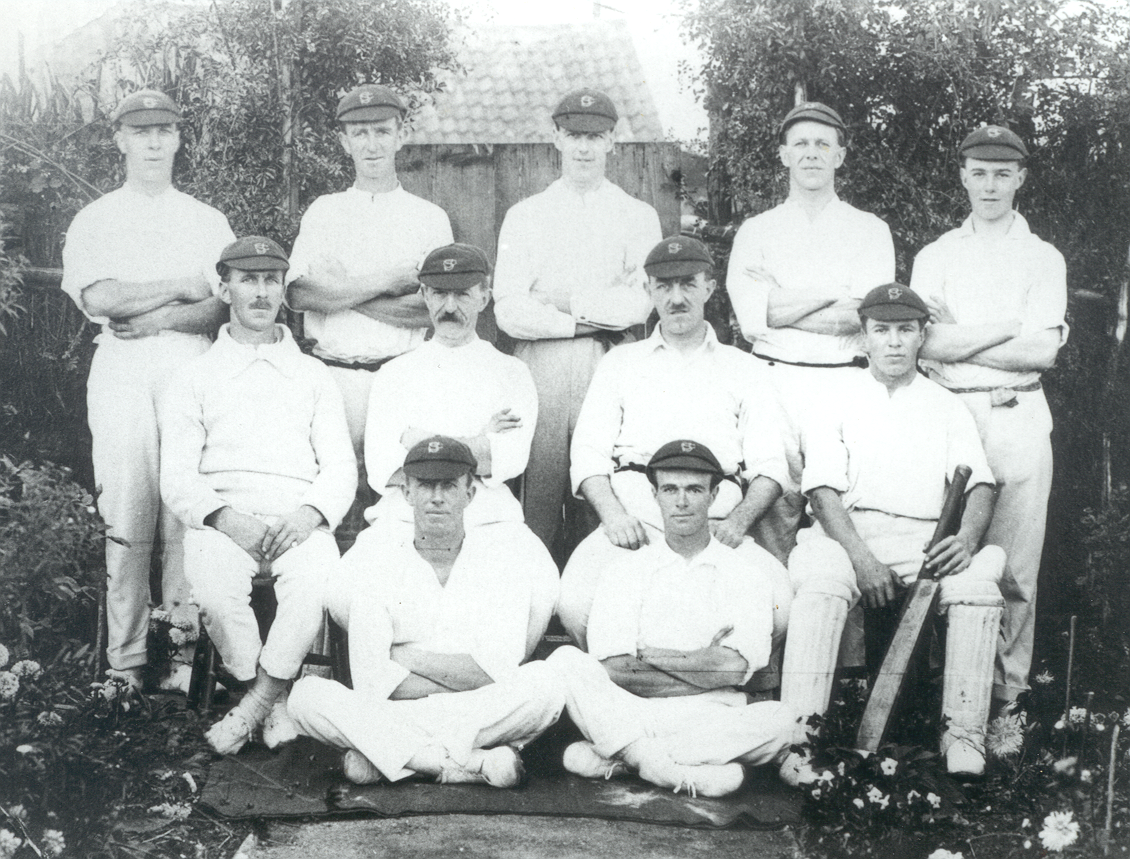
Eleven men in cricket whites, aged perhaps between twenty and sixty, their smart whites only let down by – or perhaps I should say only held up by – the cords around their waists. The rug displays telltale signs of freshly whitened boots, though possibly not using Quinn’s Vestal Cream that, according to The Cricketer magazine in 1922, ‘Dries pure white and WON’T RUB OFF’. The men’s caps connote commitment to the game, and under closer magnification sport a monogram of interlocking letters that reads SCC, perhaps purchased from E. C. Devereux’s of Eton, ‘Suppliers to all Test Match XI’s… each cap made to suit customer’s own measurements’, as advertised in The Cricketer in 1926.
My mother thought that the photograph had something to do with one of the aunts. But with a matriline family tree rooted firmly in Kentish soil, yielding an abundant crop of agricultural labourers and domestic servants, it took me a good many years to make the connection to Harriett Norris, one of my mother’s twenty-four great aunts who lived to adulthood. What transpires to be truly remarkable about the photograph is that it is of the Swingate Cricket Club, made up of a father and his ten sons.
William Stephen Norris (second from the left in the middle row) was sixty-two when the photograph was taken. Immediately to his left is his thirty-eight-year-old eldest son, William Thomas. The youngest boy is Stephen, aged eighteen, standing at the back on the right. My mother’s great Aunt Harriett was William Stephen’s wife and the mother of all ten boys. By the time Stephen was born in March 1908 she and William had been married for twenty-one years and she had given birth to fifteen children; this means that in all likelihood Harriett had been pregnant for more than half her married life.
But Harriett is missing from the photograph. Armed only with these details in 2015 I embarked on a trail to find out more about Harriett and her family.
My search for Harriett
On a cold spring morning in 2015 I was at the church of St Margaret of Antioch, at St Margaret’s-at-Cliffe on the east Kent coast. Gulls reeled over the squat Norman tower, built of local flint and limestone from just across the Channel.
I always enter graveyards with a sense of optimism – a sense that some spiritual guide will draw me to my ancestors’ graves – but on that morning I had once again fallen back on a row-by-row search of the stones. These stones, rather than presenting themselves in neat lines, had been tossed about on a rolling green sea of turf, some capsized beneath overgrown yews, and most with inscriptions weathered by the salt-sea winds. But pertinacity pays, and after an hour, on hands and knees, I was peeling back the swelling turf to reveal a low kerb of granite that marked the plot. Deep damage to some of the stone showed that whoever mowed there, mowed without reverence. Only a few words above the ground had given them away, but, working around the perimeter, armed with my notebook and pencil to fill in where thin lead letters had long since peeled from the granite, I read:
In loving memory of William Stephen Norris, born 4th September 1863, died 6th January 1928 / Also of his wife Harriett Norris, born 7th November 1864, died 1st September 1950 / until the day break. Re-united
According to a newspaper report it was on the very spot on which I was standing that on a cold, overcast day in January 1928 that thirty family members stood to support Harriett, twenty-one of them with the surname NORRIS.
There are ten sons in the photograph but William and Harriett also had five daughters, three of whom died in infancy. The birth rate in England peaked in the 1870s and then declined into the twentieth century and large families became less common, but hard facts on family size are hard to come by until the 1911 census, which suggests that by that time only one in a thousand families included fourteen or more members.
This same decennial census, taken on the night of 2 April 1911, came at just the right time to capture the Norrises all under one roof at The Chance Inn at Guston. Stephen is just three years old, whilst later that same year, eldest son William Thomas would marry and move a mile up the road. The Chance Inn is just three miles from St Margaret’s churchyard.
As I descended from the clifftops, having walked from Dover that cold spring morning in 2015, the single-track lane opened out to reveal St Margaret’s Museum, situated in a tea-room, looking for all the world like a residential house, and betrayed only by a small sign and a concreted-over front garden forming a small car park. The museum, no more than a room at the back of the shop, was dedicated to the village’s role in the two world wars. Thirty-one of the one hundred and fifty-three local men who fought in the First World War lost their lives. Seven of Harriett and William’s sons saw service in that war and so by my reckoning, based on the local experience, the chances of all seven NORRIS sons returning would have been just twenty per cent. Harriett and William must have spent many nights in fear of the telegram boy on his bicycle.
I walked the three miles onwards from St Margaret of Antioch’s Church to visit The Chance Inn at Guston, past chalk-strewn ploughed fields, perhaps just flat enough to stage a game of cricket. The Inn itself stands near a junction where The Street meets The Lane, a small, disjointed building, as if two roadside cottages of differing ages and proportions have been pushed together. The front door led directly onto the bar with a middle-aged lady behind it. Briefly unsure of myself, and wanting to take in my surroundings, I ordered a pint of a local beer, something to open up the conversation.
It was just the two of us. A few self-conscious minutes passed before I asked, ‘Have ever you heard of the Norrises? They lived here a hundred years ago; a father and ten sons who formed a cricket team.’
‘We’ve only just moved here. But I think I’ve heard some of the regulars talk about them. Are you related?’
‘Distantly.’
She introduced herself as Leanne and I showed her a copy of the crowded 1911 census return and an advert for the freehold of The Chance Inn that appeared in the Dover Express in 1911. It sold for £900 in September that year, when William was paying rent of £40 per annum – around the annual wage of an agricultural labourer at the time. The advert says the property comprised a Large Bar, Club Room, Bar Parlour, Sitting Room, Dining Room, Six Bedrooms, Kitchen, Cellar, and the usual Offices, with Yard and Large Garden at the rear.
‘It cost a bit more than that now,’ says Leanne. ‘Six bedrooms. I really have no idea where you could fit six bedrooms in this place.’
It was at that point that I noticed a photograph hanging on the wall. It was one I hadn’t seen before, and yet one I instantly knew connected to this story.
‘This is the Norrises’, I said. And indeed it was. Fourteen of them, impeccably dressed; the men and the older boys in three piece suits with starched Eton collars, the eight- and the nine-year-old boys in paler colours with three-quarter-length britches and the two youngest in white.
‘Oh yes, I’d forgotten about that.’
‘This is brilliant. It’s earlier than I’ve seen before, and it’s also the first photograph of the woman I’ve been looking for – Harriett, the mother.’
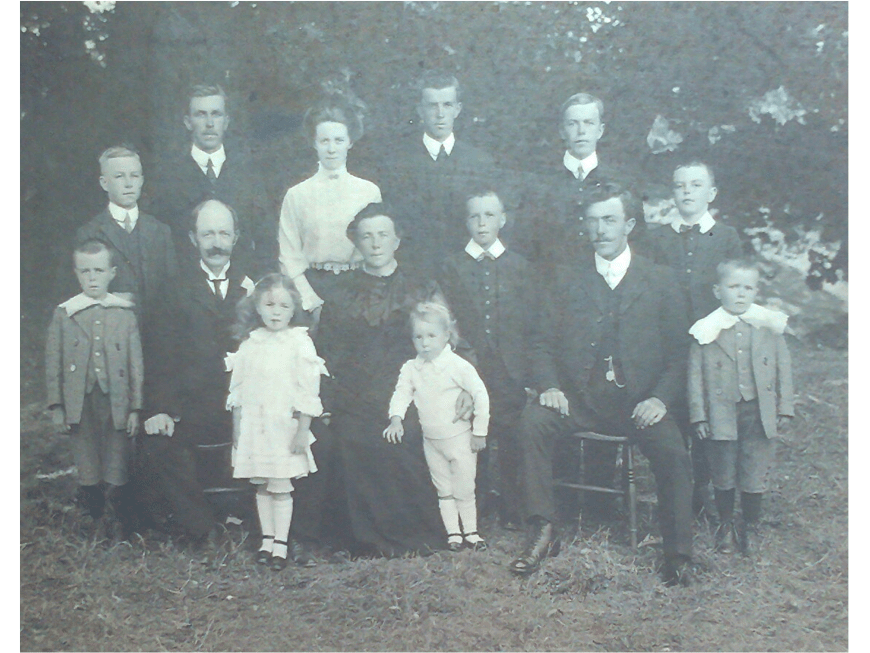
And here she is, in the centre of her whole family, leaving her husband William, perhaps rather curiously for a family portrait, to one side on her immediate right. Harriett looks business-like, yet kind; a woman who might suffer no nonsense, but with a protective arm around the youngest of her brood. The centre of the family.
‘Would you mind if I took a copy?
‘No, go ahead. But I think there’s something on the back. Take it down and bring it over here then you can see, and get a better picture.’
I took the photograph off the wall and placed it on the bar in order to look more closely. On the back, on cracked and disintegrating brown paper, the inscription read, ‘Presented To Carrie Elsie Norris from Her Parents Aug 13th 1911’.
Leanne and I speculated for some time over the date. Carrie would have been six and a half and it seems a somewhat strange present to give to an Edwardian child. Happy but somewhat mystified, I offered Leanne a copy of all the documents I’d collected and we exchanged contact details. She gratefully accepted, declining only the copies of Violet and Evelyn’s death certificates. They both died here at The Chance Inn whilst still in infancy, one from whooping cough, the other from diarrhoea, and so perhaps not ideal adornments for the Inn’s dining room.
Swingate Inn
I left The Chance Inn and walked down Hangman’s Lane, one mile later coming to the junction with the busy main Dover to Deal road. Crossing the road, I took a small track opposite that leads to a farm. On the left is the back of the Swingate Inn, where the Norrises moved at the end of the First World War. On the right lies a field where the 1876 Ordnance Survey map has a ‘Cricketers’ Booth’ marked. The field was ploughed, but as the sun came out from behind scudding clouds, it was as if I could hear again the sharp crack of leather on willow and excited shouts of ‘Stay’ and ‘Yes’ and murmurs of appreciation for a good delivery or a deftly taken single.
It was at the Swingate Inn that the cricket team was based. They played as either the Swingate Cricket Club or Mr Norris’s XI. William NORRIS was landlord from at least 1921 until his death seven years later. By working through copies of the Dover Express and East Kent News for the inter-war years I have found batting and bowling averages for twelve of the years from 1923 to 1939. During those years the team played more than twenty games a year – thirty-five in 1926 – often with a brother-in-law making up the numbers. Douglas rarely played, managing only nineteen games in twelve years – a descendant later told me he had cows to milk – and so I have found just one printed scorecard showing William and his ten sons. A low scoring, but close fought, midweek match that took place on 29 June 1921 with eldest son William Thomas the only man to make double figures, but some good fielding by the Norrises, yielding four run-outs to secure the win by a single run.
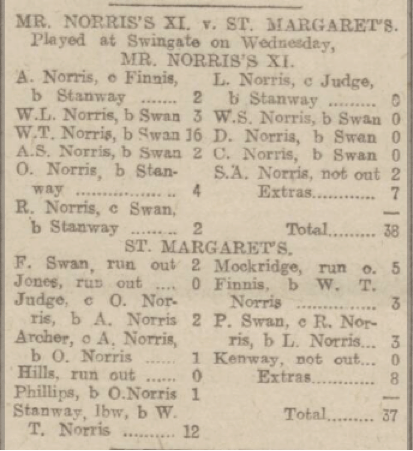
Cricket and childbearing ran in this family’s blood. When eldest son William Thomas married his fiancée in September 1911 she was already three months pregnant with William Edwin Norris, and a few days before the game above, William Edwin, just a few weeks ahead of his tenth birthday, came in at number eleven for the Norrises — three William Norrises – grandfather, father and son – all playing for the team.
Cricket and society
Cricket was immensely more popular then than now. Williams (1999) estimates that by the late 1920s as many as 400,000 were playing cricket each week: a figure that excludes cricket played in schools. Was there more time; time for these rituals, the whites, the pads, the teas, the fresh-cut grass and the warmth of long summer evenings? Our ancestors had just the same number of hours in the day as we do, perhaps though they were more in touch with the natural rhythms of the seasons and the passing years?
In the early twentieth century cricket uniquely spanned the social classes. The working classes had football, rugby league… and cricket, whilst the upper and middle classes had rugby union, golf, croquet… and cricket. The Norrises might have simply been the family team from the local village pub, but on Whit Monday 1926, against the grandiloquent Bandsmen of the Lancashire Fusiliers, Claude scored 116 in seventy-five minutes, hitting seven sixes and eleven fours, as Swingate amassed a total of 203. In response the Fusiliers managed just twenty-two in the first, and seventeen in their second innings. The Fusiliers’ forlorn one-and-a-half-mile march back to barracks at Dover Castle was no doubt lubricated by the Norrises’ hospitality.
Cricket is a team game, one where players train and socialise together, and yet, either at the crease – taking guard with bat in hand, or, at the start of the run-up with the ball in hand – everything is down to the individual, a pitting of wits: batsman against bowler. The mathematician G. H. Hardy said, ‘Cricket is the only game where you are playing against eleven of the other side and ten of your own.’ A mathematician’s paradise: a world of averages, career totals and spectacular feats. In June 1922 Wilfred Lionel had just turned twenty years of age when he achieved the double hat trick – four wickets with four successive balls; a rare occurrence at any level of the game. Wilfred was William and Harriett’s eighth son; was it Harriett or William I wonder that hid, ‘Red Lion’ right there in the middle of his Christian names?
Finding Harriett?
The mystery of Carrie’s photograph was still on my mind. I was walking back along the clifftop path to Dover, with the low setting sun silhouetting the castle to my right, whilst to my left a thin pale orange band of the Cap Blanc-Nez was clearly illuminated twenty miles across the sea. What could be significant about 13 August 1911? The answer came to me suddenly. Twenty-five years and one day before that date William and Harriett were married, and so the photograph is a commemoration of a silver wedding celebration, with a copy given to each child. With the 12th of August falling on a Saturday in 1911 it no doubt made good business sense to delay the family get-together by just one day.
Harriett died at home in Vale View on 1 September 1950 at the age of eighty-five of broncho-pneumonia and also heart disease. Her daughter Beatrice was present at her death. Twenty-six Norrises were among the over forty mourners at her funeral. By my reckoning at the time of her death she had at least eighty living descendants. I hoped that Harriett’s obituary might tell me a little more about her, but any hopes I might have had of that were immediately dashed by the headline, ‘Death of Mrs W. S. Norris – Her husband and sons made a cricket team’.
Have I found Harriett? What would it even mean to say I had found a lady who died almost three-quarters of a century ago? I have visited her grave, paid my respects, captured something of her story, and traced many of Harriett and William’s great-grandchildren – third cousins of mine – all descendants of my 2 x great grandparents Thomas ROBERTS (1840-1920) and Mary ROBERTS (nee SPICE) (1839-1929). Perhaps this text or something like it can live on amongst Harriett’s descendants. That would be good. It’s probably the best I can do.
Bibliography
- Cricketer, 1923. The Cricketer, II(2), pii
- Cricketer, 1926. The Cricketer, VII(2), p33
- Dover Express, 1928, 20 January, p5c [WSN funeral report]
- www.visionofbritain.org.uk/census/table/EW1911GEN_M63
- Dover Express, 1911, 29 September, p8d [Chance Inn sale]
- Dover Express, 1921, 1 July, p8c [scorecard image]
- Dover Express, 1921, 24 June, p8d [grandfather, father and son]
- Williams, J. 1999. Cricket and England: A Cultural and Social History of the Inter-war Years. Oxford: Frank Cass.
- Dover Express, 1926, 28 May, p15c [Swingate v Fusilliers]
- Hardy, G.H. 1967. A Mathematician’s Apology. Cambridge: CUP
- Dover Express, 1922, 16 June, p15b [double hat-trick]
- Dover Express, 1950, 8 September, p8f [HN funeral report]

 My Ancestors
Leave a comment